


A clearer standard for trading software.
binXbase brings live market intelligence, deliberate execution mechanics and a real ledger into one calm workspace — so people can understand the system before they put money behind a decision.
What this is
binXbase is a crypto exchange with live market data and a real double-entry ledger. Every price, order book, trade print and candle on this site is read from a public venue feed. Balances settle against that ledger; on configured mainnet networks, on-chain deposits credit spendable balances and human-reviewed withdrawals pay from a shared treasury.
Orders still fill against a mirrored book inside this product — they are not routed to the venue. That keeps the terminal honest about depth and fees without claiming exchange matching on a licensed venue. binXbase does not invent a regulator or a licence on this page.
Live
market intelligence
Real
double-entry ledger
Clear
execution boundaries
Global
from one workspace
Who is behind this
binXbaseis a crypto exchange and Web3-AI company, founded in 2026, based in Dubai, United Arab Emirates, and serving a global audience. The company holds certification to ISO/IEC 27001 for information security management and to PCI DSS v4.0.1. Both are certifications of the company’s own systems and neither is a financial licence; the certifying body, the certificate number and the scope each covers will be published here, and until they are, treat the two names as the claim they are rather than as something you can check. Registration particulars follow the same rule.
What it will not claim: binXbase does not hold an exchange licence and is not supervised by a financial regulator, and nothing on this site is a regulated service. There are no trust badges here, no user counts, no team grid and no support desk. On an exchange every one of those details is something a reader might rely on, so every claim on this site is either checkable or labelled as not yet checkable — the two certifications above wear that label — and never dressed as more than it is.
How this works, in fullOpen ecosystem
Connected to the tools that move the industry forward.
The experience is ours. The underlying facts stay close to their sources, so every market, asset, rate and insight can be traced back to a recognisable name.
These are data and infrastructure sources used by the product, not sponsorship or endorsement claims.
Binance
Public spot & futures market data
CoinGecko
Asset reference intelligence
European Central Bank
Daily fiat reference rates
Anthropic
AI commentary from market context
Where the line falls
Three states rather than two. “Live market data” and “ledger balances” are not the same thing as “your order hit the venue” — and the third state has to be told apart from both: what cannot happen here, whether because it was never built or because it is refused on purpose (no KYC product surface, no named financial regulator, no unsupervised auto-payout).
Outside — the market
Read from a public venue feed. Not ours, not smoothed, not delayed on purpose.
- Last price, 24-hour change, high, low and volume
- The order book — twenty levels, republished about ten times a second
- The trade tape — the venue’s own prints, not a simulation of activity
- Candles, including the minute still forming
- Funding rate, mark price and open interest on every perpetual
- Tick size, lot size, minimum notional and whether a pair trades at all
Inside — this product
Balances and fills in a double-entry ledger; settlement on configured networks.
- Your balances — the sum of every entry ever written against your account
- Orders, fills, reservations and their state transitions
- Fees, charged on a fill and accrued to an internal account
- Perpetual positions: margin, funding, unrealised PnL and liquidation
- Conversions between assets within your Balance
- Lending supply, collateral, debt, repayment and funded reward credits
- On-chain deposits credited after confirmations; withdrawals after human review
A maker side and its rebate. A KYC product surface. A named financial regulator supervising this build. Unsupervised auto-payouts. None of those are claimed here. On-chain deposits and withdrawals, by contrast, are live on configured mainnets — every withdrawal still waits for one human approve-or-reject decision before treasury payout.
This is the summary. How this works draws the same line row by row, follows one order from the ticket to the ledger entries that settle it, and describes what happens when the feed stops.
The outside half has named sources, and they are the only ones. Market data — prices, books, trades, candles, funding — comes from Binance’s public feeds. Asset reference data comes from CoinGecko, and fiat reference rates from the European Central Bank. The AI commentary is generated by Anthropic’s API from numbers this site hands it; no account information goes with them.
Why live data and a ledger
It is the harder of the two ways to build this, and the reason to prefer it is that the easy way teaches the wrong things with great confidence.
A made-up market teaches made-up lessons
If the prices are generated, then slippage is a parameter somebody chose, depth is whatever the generator felt like, and the pair behaves the way its author expected markets to behave. Everything learned from it is a fact about the author. So the data here is not modelled — it is read from the venue and passed through, and the site says out loud when that path is degraded.
The money was never the lesson
Reading a book, sizing a position, knowing what a round trip costs, watching funding quietly drain a perpetual held through the hour: none of that needs the money to be yours. What real money adds is the stake — and the stake is the part that makes a beginner learn fastest in the wrong direction, because from inside a profitable accident it looks exactly like a good decision.
So the constraints are real instead
Tick size, lot size, minimum notional, the depth actually quoted at the instant the button is pressed, the fee, the maintenance margin, the funding owed for holding through the hour. An order fills by walking the live book level by level, so size costs what size costs and a large order gets a worse average than a small one. What has been removed is the loss, and nothing else.
And the edges are published, not hidden
Orders still fill inside this product’s plan, so the venue’s book never moves from a click here; an order never rests on that book, so it never earns a queue position or a maker rebate; and nobody faster ever takes the level being aimed at. What this does not simulate lists every one of them, because a simulator that hides its own edges is the most misleading kind.
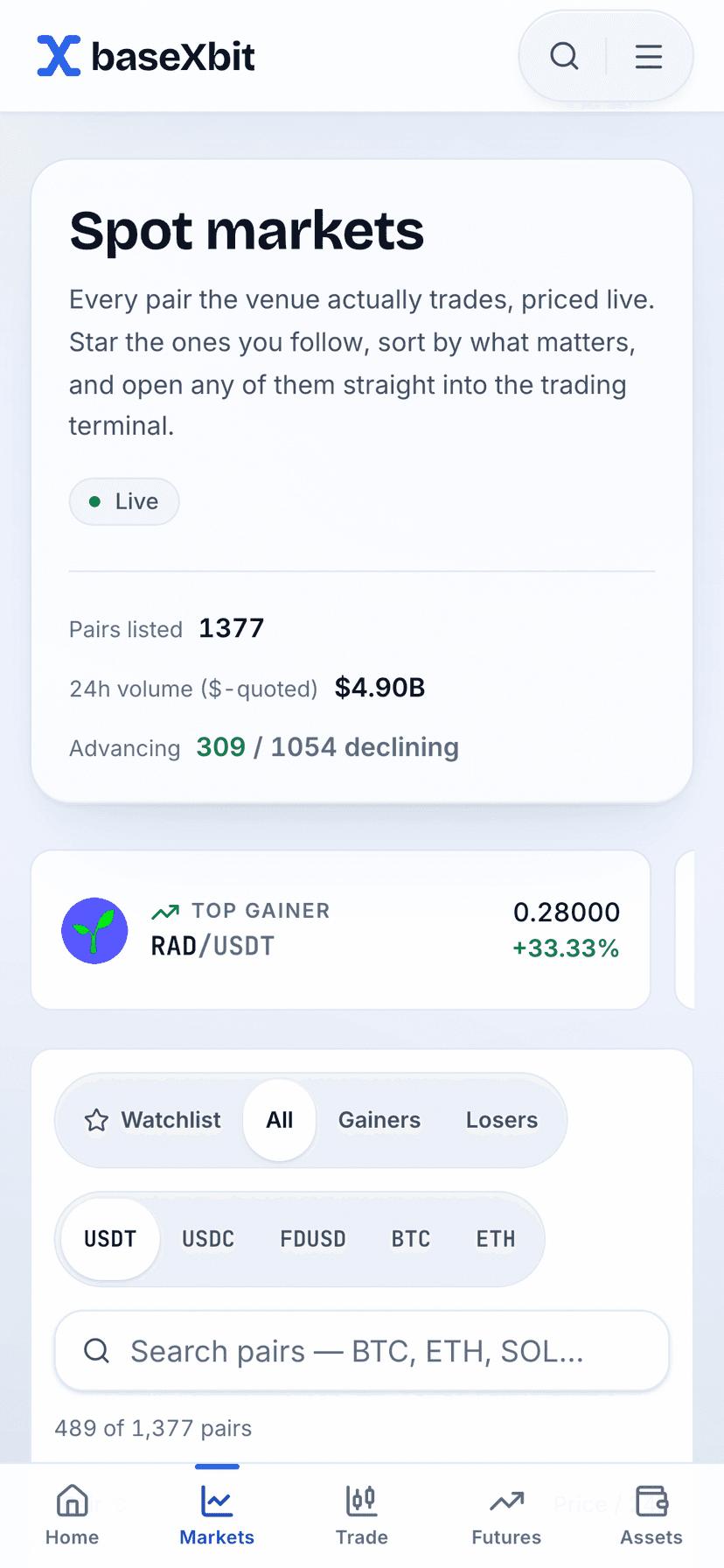
The markets board on a phone, captured from this product against the live venue. Every number in it came from the market. Every number an account would show beside them did not.
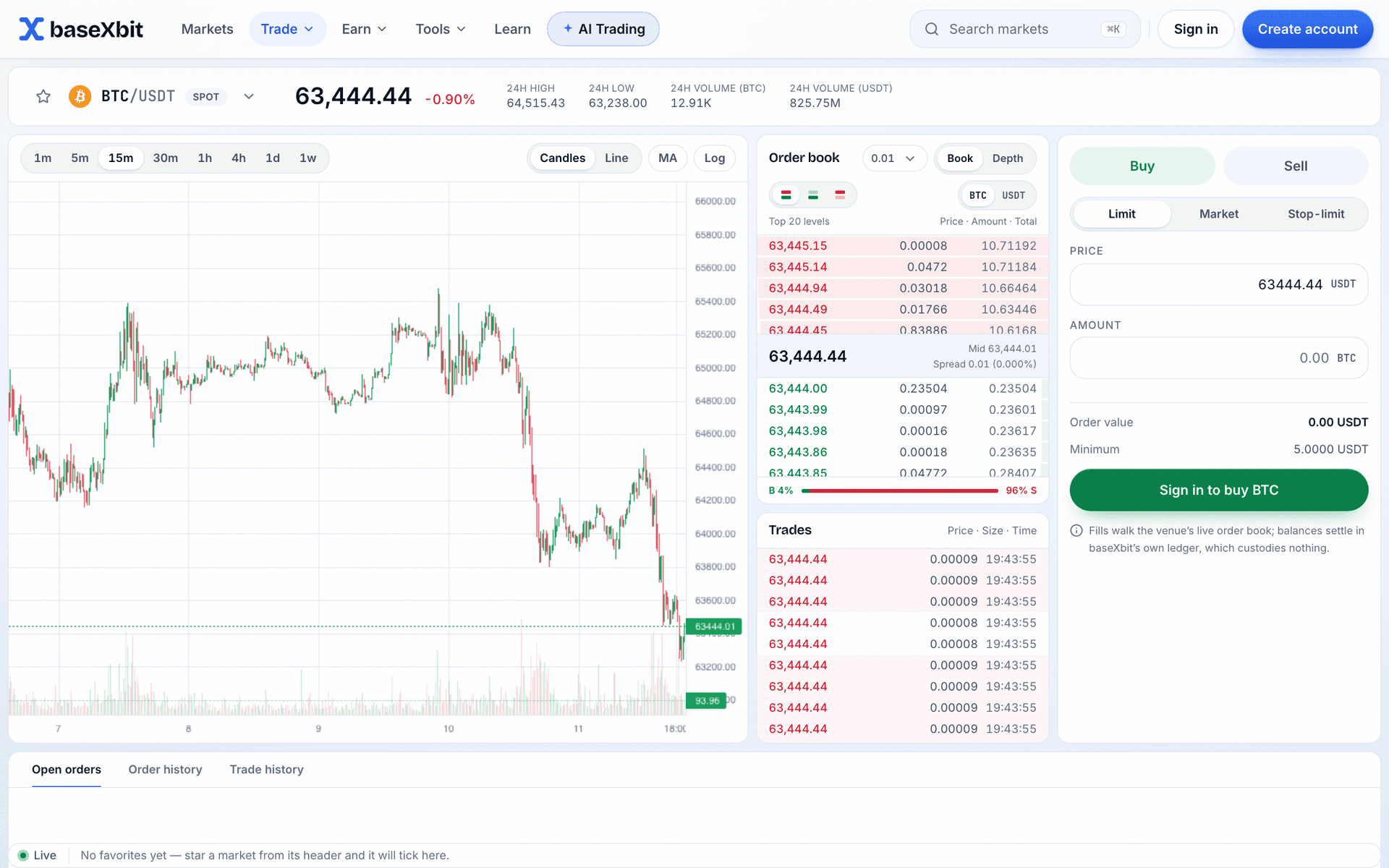
What this refuses to do
Any exchange can show a board of prices. What separates one from another is what it declines to put on the page beside them — and each of these had to be decided again every time a new surface was built, which is why the list is the closest thing this product has to an identity.
No fiat custody rail
No bank, no card rail, no fiat counterparty. Crypto settlement uses company-controlled wallets on configured mainnet networks, with balances tracked in the ledger. Sending to a wrong network or address can still lose funds — the product cannot invent a recovery path that does not exist.
No card or bank charge
Nothing on this site takes fiat payment. On-chain deposits credit the ledger after confirmations; a separate faucet, when a deployment still offers one, issues demo credits against an internal contra account and the page it lives on says so. Production keeps that faucet off whenever withdrawals are on.
No unsupervised auto-payout
The withdrawal surface reports the deployment’s actual payout state, history and any cancellable request. Every withdrawal locks its balance for one human approve-or-reject decision before treasury payout. There is no KYC gate and no claim that a financial regulator supervises the rail.
No advice, and no signals
Nothing here is a recommendation to transact. The AI commentary is written by a language model handed this venue’s live numbers, it is labelled as generated wherever it appears, and it can be confidently wrong.
No real yield or custody-backed earn
Staking remains an explanation with no APY. The lending lab does display rates derived from its own USDT utilization model, but no external yield or insured return is promised. Supplier credits exist only when borrower interest is actually paid on the ledger.
No token, no points, no presale
There is nothing to buy that is not a market on the board. Rewards credits only the test ledger: settled-fee rebates and fully reserved campaign claims, with immutable signup attribution. Those receipts are not a token, cash balance, presale or claim against an external party.
No data sold, and nothing to consent to
No advertising network, no analytics vendor, no tracking pixel. Reading this site signed out sets no cookie at all, and the ones signing in does set are this site’s own, which is why there is no cookie banner — Privacy lists every one of them.
No credential it cannot cite
binXbase is a company, founded in 2026 — and that is where the corporate copy stops. No licence is implied, no regulator is named, and no badge or seal appears anywhere on this site, because a credential a reader cannot check is decoration wearing the clothes of proof. The card at the top of this page says exactly what does and does not stand behind the name.
No proof of reserves
There are no reserves, so any ratio would attest to nothing and a fabricated attestation is strictly worse than none. What sits in that slot instead is a live health reading you can check yourself.
No maker rebate
Your order never rests on the venue’s book, so it never provides liquidity that anyone could trade against. Paying you a rebate would be paying for something that did not happen — so every fill is a taker fill, and there is no volume tier to climb. Fees publishes each charge and the arithmetic that produces it.
One rule sits underneath all of them: never show a control that appears to move money when it cannot. The order ticket validates the venue’s real rules against what you typed and still reads “Sign in to buy” — it never looks armed when it cannot act.
Who this is for
Both halves matter. A product that describes only who it suits is describing a market, not itself.
Worth your time if
- You want to learn a trading terminal, and would rather do it against the market than against a tutorial.
- You want to see what an exchange is actually doing underneath: a book, a match, a fee, a margin call, a ledger that has to balance.
- You are checking how an order behaves — a stop that triggers on a print, a limit that rests, a perpetual carried through funding — and want the mechanics right and the stake gone.
- You want live market data over plain HTTP and server-sent events, with no key to request and no signup in the way.
Not what you came for if
- You expect every order to reach a licensed venue’s matching engine. Fills here walk a mirrored book inside this product.
- You want unsupervised auto-withdrawals. Every payout still waits for a human approve-or-reject decision.
- You need a venue with a regulator behind it. binXbase does not claim an exchange licence and does not name a financial regulator that supervises this product.
- You want to be told what to buy. Nothing on this site is advice, including the part a language model wrote.
What is built, and what is only written down
Everything on the left can be opened right now and watched working against the live feed. Everything on the right has a page of its own that explains the mechanism properly and names the concrete thing it is waiting on, because “coming soon” tells a visitor nothing.
Built, and running against the live feed
Live spot and perpetual boards
Every pair the venue actually trades, filtered against its live catalogue.
Chart, order book, trade tape and a ticket that validates the venue’s own rules.
USDT-margined perpetuals with leverage fixed at open, funding and liquidation.
Market, limit and stop-limit orders
Limits rest until they fill or you cancel; stops trigger on a trade print, not a quote.
One write path, which refuses to write a transfer whose legs do not sum to zero.
One Balance for deposits, trading, futures margin and earn, and live convert quotes.
Screener, cross rates and market cap, all priced from the same feed as the board.
The routes this site is built on, documented from the handlers that serve them.
Re-verifies the current password, commits a new scrypt hash under a row lock, then signs out this browser.
Fee rebates, referrals and funded campaigns
Claims settled-fill rebates, fixes referral attribution at signup, and pays only campaigns whose complete winner cap was reserved first.
Supplies test balances, borrows USDT against BTC or ETH, accrues deterministic debt, repays and liquidates against fresh server marks.
Specified, and not built
The mechanism is published in full and no rate is shown, because there is none.
Nothing is published to either store, and that page says which one in each case.
API keys and any write endpoint
Reads need no key. Keys arrive when there is something that can trade with them.
Two-factor and remote session revocation
Both are missing. Existing stateless JWTs on other devices remain valid until they expire.
Deleting an account removes everything attached to it; you cannot yet do it yourself.
On-chain deposits and withdrawals. Their state machines, account pages and histories run on configured mainnet networks (primary: BNB Smart Chain). Every withdrawal still waits for one human approve-or-reject decision. This strip is not a licence claim: the product does not name a financial regulator that supervises it, and there is no KYC gate.
A maker side appears in neither column — it is refused, for the reasons above, and no date would make it arrive. On-chain deposits and withdrawals are live on configured mainnets with human-reviewed treasury payouts. That is not a licence claim: there is still no KYC product surface and no named financial regulator on this site.
How this is kept honest
Honesty on a site about money is not a tone, it is a handful of rules that cost something to follow. These are the ones a visitor can see from the outside.
The disclosure is on every page, at reading size
It sits in the footer in body text rather than fine print, never behind a toggle: live market data, ledger balances, mainnet settlement on configured networks, human-reviewed withdrawals, no invented licence. It is the statement of record, and no page is allowed to contradict it — including this one.
A number with no source is not printed
A statistic whose input is missing is omitted rather than zeroed, because a zero renders as a real-looking figure someone can act on. Rates and fees shown in copy are imported from the code that charges them rather than retyped, so a documented number cannot quietly drift from the real one.
Every charge is published, including its rounding
Fees lists each charge in the product and the arithmetic behind it, down to the direction of rounding: quantities round down and fees round up. Rounding a quantity up would spend money the account does not have.
Degraded data says so
A frozen price looks exactly like a stable one, so the boards carry their own feed status and system status reports the ingest worker rather than the web server. A health check that stays green while every price is an hour stale is worse than no health check.
An empty surface names what it is waiting on
Every unbuilt page states what it will do and the specific thing that has to exist first. “Coming soon” tells a reader nothing and quietly implies the rest of the product might be equally notional.
Where to go next
Four doors, in increasing order of how much you want to check for yourself.
- Just go and lookEvery pair the venue actually trades, priced live. Cross-check any of them against the venue in another tab.
- Learn the machineryLessons on the book, the orders that touch it, what a fill costs, perpetuals and funding — each ending on a live terminal to try it.
- The premise, argued properlyThe data path, the failure modes, what an order does to the ledger, and the line between real and paper drawn row by row.
- The API behind the pagesThe read endpoints this site is built on, documented from the route code, including the event streams and the health check.